What Was the Stamp Act? A History
Everything you need to know about one of American history’s most consequential laws
Readers of Stamps Forever often ask about the Stamp Act of 1765, perhaps assuming it was connected to the history of U.S. postage stamps. In fact, the Stamp Act was not a postal measure, and it predated the first U.S. postage stamps by more than 80 years. Instead, it imposed a tax on printed paper throughout the American colonies and helped fuel growing resistance that contributed to the American Revolution.
The Stamp Act of 1765
On March 22, 1765, the British Parliament passed a new tax that would touch nearly every corner of colonial life. The Stamp Act was scheduled to take effect later that year on November 1. At that time, American colonists would be required to pay a tax on a wide array of paper materials, including newspapers, pamphlets, legal documents, licenses, mortgages, contracts, and bills of sale. These items had to be printed on special government-issued paper that already carried an embossed revenue mark showing that the tax had been paid.
From the Crown's perspective, the measure seemed reasonable. Britain had only recently driven France from North America during the French and Indian War, taking on a large national debt in the process. Maintaining thousands of troops on the American frontier also carried a significant cost, and Parliament saw the Stamp Act as a way to help raise needed revenue.
Many colonists, however, saw the act very differently. Accustomed to governing their own affairs and raising their own taxes through their colonial legislatures, they refused to be taxed without their consent. They were also alarmed by a section of the law that appeared to threaten the right to trial by jury.
Resistance began almost immediately. In May 1765, Virginia’s House of Burgesses passed a series of Stamp Act Resolves introduced by a young Patrick Henry. The Resolves asserted the colonists’ right to govern their internal affairs and questioned Parliament’s authority to tax the colonies. Published throughout British America, they encouraged other colonial assemblies to adopt similar positions.
Opposition soon spread beyond legislative halls and into the streets. During the summer of 1765, crowds in Boston intimidated stamp distributors and destroyed the property of government officials. Protesters gathered beneath “liberty trees,” where they hung effigies of stamp distributors and royal officials. Before long, many of these groups adopted a new name: the Sons of Liberty.
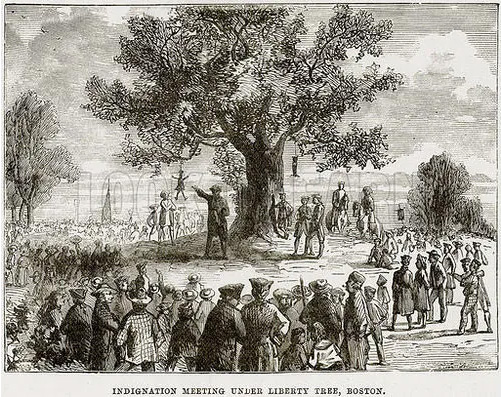
The most organized response came in October, when delegates from nine colonies gathered in New York City for the Stamp Act Congress. There, they issued a declaration defending the rights and grievances of the British American colonists, including “the undoubted rights of Englishmen, that no taxes should be imposed on them, but with their own consent.” The delegates also called directly for repeal of the Stamp Act.
By November 1765, opposition to the law had become so widespread that enforcing it was nearly impossible. Boycotts of British goods began affecting trade in colonial cities, and merchants on both sides of the Atlantic joined the growing calls for repeal.
Facing mounting pressure, Parliament reversed its course. In February 1766, it passed a bill repealing the Stamp Act, and on March 18, King George III signed the repeal into law.
News of the repeal sparked celebrations throughout the colonies. Church bells rang. Cannons fired. Houses were illuminated at night, and celebratory verses circulated from town to town.
The repeal ended the immediate crisis, but it did not resolve the larger debate over “taxation without representation,” which continued to fuel tensions in the years leading up to the American Revolution. The Stamp Act crisis had nevertheless changed the colonies. Writing in his diary in December 1765, John Adams observed that ordinary people had become “more attentive to their Liberties, more inquisitive about them, and more determined to defend them, than they were ever before known or had occasion to be.”
A Postage Stamp Celebrating the Stamp Act Protest
In 2016, the Postal Service commemorated the 250th anniversary of the repeal of the Stamp Act with a Forever stamp inspired by the public celebrations that swept through the colonies after news of the repeal arrived from Britain.
Created by noted historical painter Greg Harlin, the stamp art depicts a crowd celebrating beneath one of the “liberty trees” associated with resistance to the Stamp Act. The scene captures the public rejoicing that followed the repeal of the act in 1766.
Art director Antonio Alcalá designed both the stamp and the pane. In the selvage area surrounding the stamps, Alcalá included a proof print of a one-penny revenue stamp like those required under the Stamp Act for printed materials such as newspapers, which were taxed at a rate of one penny per sheet. The selvage also features one of the most enduring slogans associated with the era: “Taxation without representation is tyranny.”
A Surviving Proof Impression
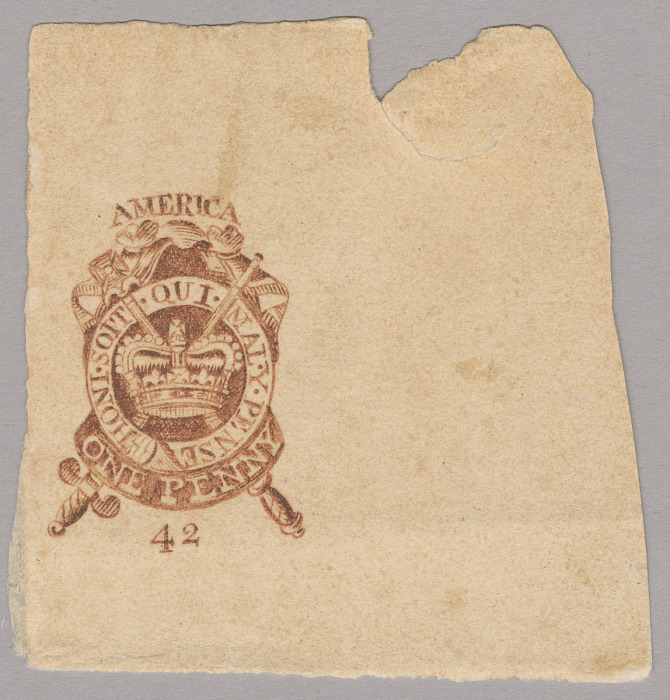
A dark red proof impression of the one-penny revenue stamp, prepared in 1765, is now preserved in the permanent collection of the Smithsonian National Postal Museum in Washington, D.C.
Printed by the British government’s Board of Stamps, this impression was produced before stamped paper was issued for use in the colonies. It served as an official sample used to review the design of the revenue mark that would be printed on government-issued paper used for taxed materials. The proof was struck in deep red ink on thick paper, rather than the materials intended for everyday use.
Today, surviving examples of these proofs are rare. Only a small number from the original 1765 impressions are known to exist, including this example from the Smithsonian’s National Philatelic Collection.