
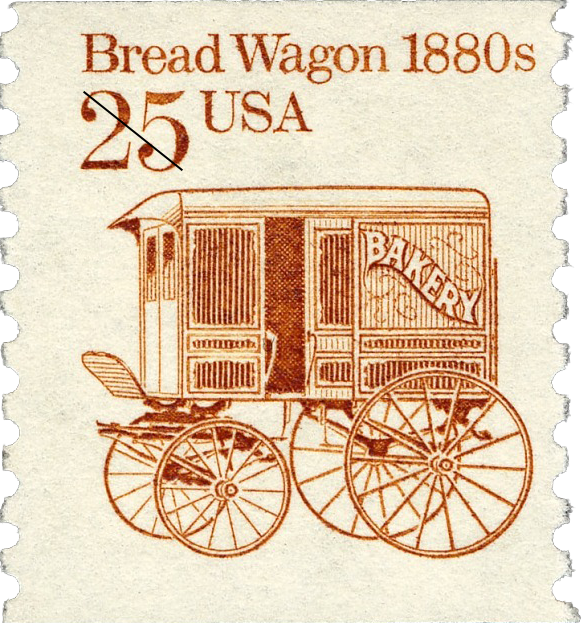
About This Stamp
The single, horse-drawn four-wheeled buggy was the most popular vehicle in America for more than a century. As Americans flocked to the cities, housing space became critical. Markets and deliveries became increasingly important as urban concentration limited the availability of land for household gardens. The picturesque, horse-drawn bread wagon became a familiar sight in neighborhoods as the driver peddled his wares. The wagon was framed with oak and floored with pine or spruce. Colorful advertisements adorned its sides.
The 25-cent Bread Wagon Transportation coil was issued on November 22, 1986, at the VAPEX stamp show in Virginia Beach, Virginia. There were 151,950 first day covers, all with plate number 1 on coils of 3,000 stamps from the B press. The stamp was intended for use in post office vending machines for mailing parcels and overweight letters. The only use for a solo 25-cent stamp was on foreign postcards to destinations other than Canada and Mexico.
The demand for the 25-cent Bread Wagon exploded when the letter rate increased to 25 cents on April 3, 1988. Plate numbers 2, 3, and 4 were printed on the C and D presses with a plate number every 48 stamps. Plate 5 was prepared for the B press in coils of 500 and 3,000 stamps with plate numbers at intervals of 52 stamps. Coils of 100, 500, and 3,000 came from the C and D presses. All stamps were block tagged.
The stamp was designed by William Bond. The vignette was engraved by Edward P. Archer, and Michael J. Ryan engraved the lettering. Both worked for the Bureau of Engraving and Printing.