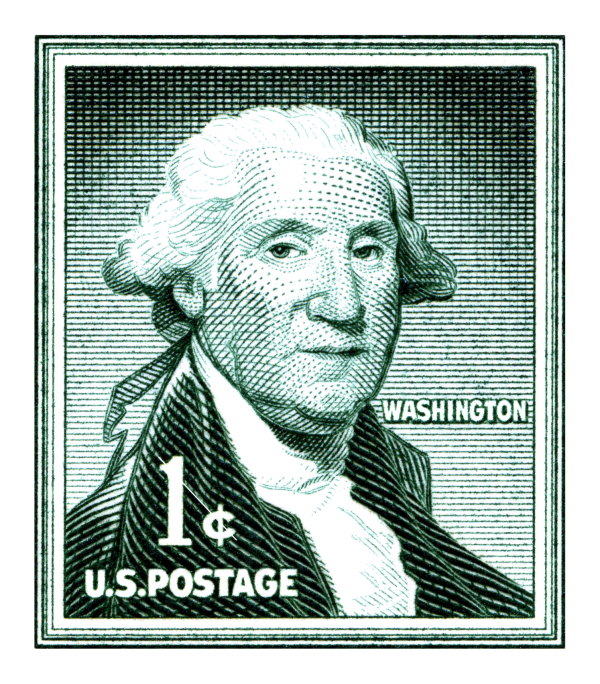
About This Stamp
The first two U.S. postage stamps, featuring George Washington and Benjamin Franklin, became valid for use on July 1, 1847.
Earlier in the year, on March 3, 1847, Congress fixed the future of the U.S. postage stamp by passing an Act to establish Post Roads "and other purposes" [Congressional Record, March 3, 1847]. It appears that stamps fell into the category of "other purposes." Effective July 1, 1847, the placement of an adhesive stamp on a letter paid its necessary postage. With the authority vested in him by the statute to prepare postage stamps, Postmaster General Cave Johnson retained Rawdon, Wright, Hatch & Edson (RWH&E), a New York City banknote engraver and printer, to print the first postage stamps. His choice was likely premised on the fact that RWH&E was the prominent firm of the time, and the firm had engraved and printed the New York Postmasters' Provisional two years prior. RWH&E became part of the American Bank Note Company in 1858.
Jacob Perkins, founder of the famous British printing firm of Perkins, Bacon and Company, invented the process by which the stamps of 1847 (and nearly all early U.S. stamps) were engraved and printed. First, a die was made by engraving, in reverse, a single image of the design. This engraving was etched into soft steel and then hardened. An arc-shaped band of soft steel called a 'transfer roll' was rocked repeatedly over the die, transferring the impression from the hardened steel die into the soft steel of the transfer roll. The image on the transfer roll was not in reverse. Next, a plate large enough to accommodate two side-by-side panes of one hundred entries each (to be laid down with 10x10 entries) was held fast to a table. Although not conclusive, evidence indicates the transfer roll was placed above the left side of the plate. The impressions were then rocked in one position at a time, starting at the top of the column and working downward, until all two hundred transfers were made. These images were in reverse, and the plate produced the positive image postage stamps.
The Benjamin Franklin stamp paid the rate for one half-ounce sent up to 300 miles. The George Washington stamp paid the rate for longer distances or heavier mail.
