
About This Stamp
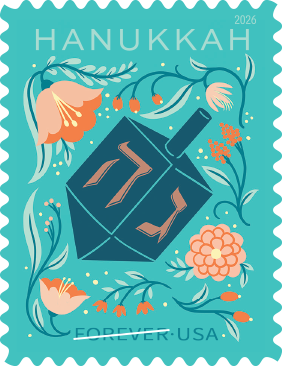
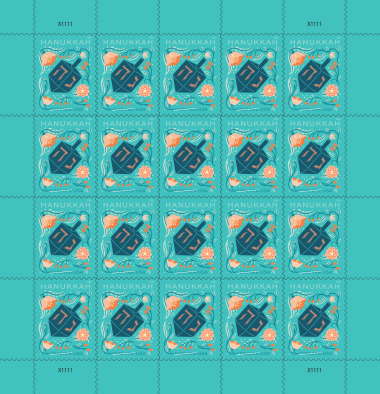
In 2026, the U.S. Postal Service issues its ninth Hanukkah stamp honoring the eight-day Jewish holiday observed by millions of people in the United States and around the world. The stamp art depicts a colorful illustration of a dreidel. USPS issued its first Hanukkah stamp in 1996, and a photograph of a dreidel also appeared on the 2004 Hanukkah stamp. Most Hanukkah stamps have highlighted illustrations and photographs of various hanukiot (the menorahs used exclusively at the Hanukkah celebration). The 2018 stamp, a joint issuance with Israel, spotlighted a hanukiah with an ornate background using the old Jewish folk art of paper cutting
Around 167 B.C.E., Antiochus IV Epiphanes, ruler of the Seleucid Empire, engaged in a brutal campaign to force Jews to convert to Greek polytheism. He persecuted those who continued to practice Judaism and desecrated the Temple in Jerusalem, which was the holiest of shrines for the Jewish people. The outnumbered Maccabees revolted and against all odds prevailed over the emperor’s much bigger armies. During the rededication of the Temple — Hanukkah is the Hebrew word for "dedication” — the sacramental oil needed to light the lamps was enough to burn for only one day; miraculously, it burned for eight days, lasting until new oil could be pressed.
Also called the Festival of Lights, Hanukkah is a time of joy celebrated with games, music, and special foods. One popular tradition is playing with a top known as a dreidel, a word that means “to turn” in Yiddish. Each of the toy’s four sides commonly bears a Hebrew letter: nun, gimel, heh, and shin. The letters represent the words “Nes gadol haya sham,” a phrase meaning “A great miracle happened there.” Instead of the letter shin, dreidels created in Israel use the letter peh for the word poe, meaning “here.”
According to Jewish folklore, when Seleucid government officials were near, Jewish children — then forbidden from studying the Torah — would hide their religious texts and take out their dreidels, pretending they were playing, not studying. However, many historians believe that the dreidel game was actually adapted in 16th-century Europe from a popular secular game called “teetotum.”
Art director Antonio Alcalá designed the stamp using illustrator Lisa Perrin’s digital artwork, which reflects both the artist’s Jewish heritage and Eastern European folk art traditions. The centerpiece of the illustration is a dark blue dreidel featuring rust-colored Hebrew letters, against a turquoise background.
The stamp project is Perrin’s first for USPS. “My father has loved and collected stamps since he was a child,” says Perrin. “He is now in his eighties and I am so honored and proud to show him a stamp that I illustrated. It’s very special to create a piece of artwork about my culture and tradition. The Hanukkah story is very much about hope and light, something I think we could all use.”
The 2026 Hanukkah stamp is being issued as a Forever® stamp. This Forever® stamp will always be equal in value to the current First-Class Mail® one-ounce price.
Stamp Art Director, Stamp Designer

Antonio Alcalá
Antonio Alcalá served on the Postmaster General’s Citizens' Stamp Advisory Committee from 2010 until 2011, when he left to become an art director for the U.S. Postal Service's stamp development program.
He is founder and co-owner of Studio A, a design practice working with museums and arts institutions. His clients include: the National Gallery of Art, Library of Congress, National Portrait Gallery, National Museum of Women in the Arts, The Phillips Collection, and Smithsonian Institution. He also lectures at colleges including the Corcoran College of Art + Design, SVA, Pratt, and MICA.
In 2008, his work and contributions to the field of graphic design were recognized with his selection as an AIGA Fellow. He has judged international competitions for the Society of Illustrators, American Illustration, AIGA, and Graphis. Alcalá also serves on the Smithsonian National Postal Museum and Poster House Museum’s advisory councils. His designs are represented in the AIGA Design Archives, the National Postal Museum, and the Library of Congress Permanent Collection of Graphic Design.
Alcalá graduated from Yale University with a BA in history and from the Yale School of Art with an MFA in graphic design. He lives with his wife in Alexandria, Virginia.
Stamp Artist

Lisa Perrin
Lisa Perrin is an award-winning illustrator, author, and educator based in Baltimore, Maryland. Her colorful, atmospheric work is informed by Eastern European Jewish folk tales and Victorian-era lithographs, as well as nature in its many forms.
Growing up in a harbor town on Long Island, New York, Perrin developed a particular interest in books and visual storytelling and planned on becoming a librarian or English teacher before pivoting to a career in illustration. After graduating with a B.F.A. in drawing and painting, as well as a B.A. in English, from the State University of New York, New Paltz, Perrin earned an M.F.A. in illustration practice from the Maryland Institute College of Art (MICA), where she currently works as a professor of illustration.
The author and illustrator of The League of Lady Poisoners (Chronicle Books, 2023), Perrin has also created art for the Harper Collins, Penguin Random House, MacMillan, Scholastic, and Little, Brown and Company publishing houses. Her many other clients include American Greetings, The Boston Globe, Buzzfeed, Smithsonian Magazine, Anthropologie, and Spotify. Perrin’s work has been recognized by The Society of Illustrators, American Illustration, and 3x3 Magazine.
In her free time, Perrin enjoys performing in two improvisational comedy troupes, exploring museums, and watching musical theater.
Hanukkah (2026) is her first project for the U.S. Postal Service.