
About This Stamp
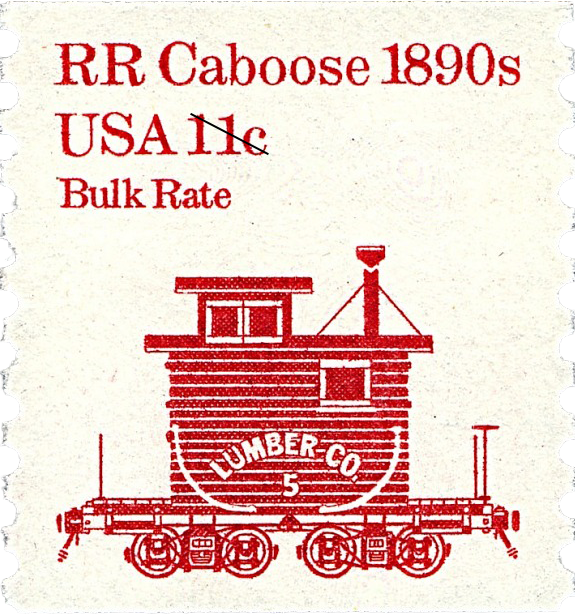
The 11-cent Caboose stamp pictures the small, narrow-gauge railroad caboose used by a logging company in the Sierra Nevada during the 1890s. It was issued on February 3, 1984, at the Chicago Philatelic Fair in Rosemont, Illinois. There were 172,753 first day covers. The stamp was intended to pay the basic third-class rate that began on May 22, 1983. When the rate was raised to 12.5 cents on February 17, 1985, the 11-cent Caboose was authorized for false franking with additional postage to be paid at the time of mailing. The stamps were withdrawn from philatelic sale on August 31, 1985.
The Caboose stamp was the first of the Transportation coils to be printed on the Cottrell press. The Bureau of Engraving and Printing printed 439.12 million of the stamps on the B press. Plate numbers were separated by 52 stamps rather than 24, as had been the case on the Cottrell press. In spite of the large number of stamps issued, only one sleeve was ever prepared for the initial printing. Only plate 1 was used. The block tagged collector edition was sold only in coils of 500. The pre-canceled service version was issued in coils of 500 and 3,000. There are no precancel gaps.
The 11-cent Caboose was reissued on September 25, 1991, for a variety of false frankings with the difference to be made up at the post office. There was no first day ceremony nor were first day covers prepared for the re-issue. As before, the stamp was printed at the Bureau of Engraving and Printing, but this time on the C or D press. Plate numbers were at intervals of 48 stamps. Only one plate, plate 2, was used. Again there were 500 or 3,000 stamps to the coil. All of the reissued stamps were untagged. There were 164.72 million stamps reprinted, all of them untagged.