

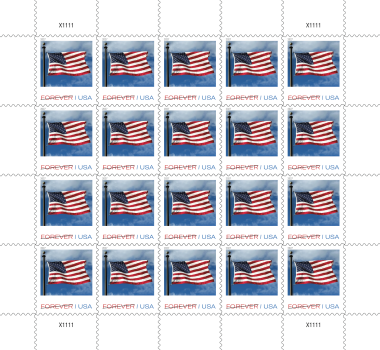
About This Stamp
As we celebrate the 250th anniversary of the Stars and Stripes in 2027, the U.S. Postal Service continues its long tradition of honoring the flag of the United States of America.
Front and center in a parade, at the opening of a sporting event, at occasions both solemn and celebratory, the U.S. flag serves as the nation’s chief visual representation of unity and patriotism.
The flag’s general design dates back to June 14, 1777. On that date — its anniversary now celebrated as Flag Day — the Continental Congress passed the first Flag Act, which specified that the flag honor the 13 original colonies with 13 alternating horizontal red and white stripes and 13 white stars in a blue field. Early flags reflected various interpretations of those guidelines.
After Vermont and Kentucky became states the flag’s design was revised to include stars and stripes numbering 15 each. Then, in 1818, the nation having grown to 20 states, Congress stipulated a return to 13 stripes. Congress also decreed that each new star would officially be added to the flag on the Fourth of July following a state’s admission to the Union.
Graced with 50 stars, today’s flag design is the longest lasting in the nation’s history. An eye-catching four-cent stamp featuring the 50-star flag was issued on July 4, 1960, when the update became official, following Hawaii's statehood the previous August.
Many stamps depicting Old Glory have been issued over the years, including stamps showing the flag over landmarks like the White House and the U.S. Capitol, and being raised during historic moments such as the 1969 moon landing and at Ground Zero in New York City in 2001.
Definitive flag stamps are the nation’s most popular stamps and the most readily available, offered not only at Post Office locations and through usps.com but also at supermarkets, pharmacies, and other retail outlets.
Stamp Art Director, Photographer

Antonio Alcalá
Antonio Alcalá served on the Postmaster General’s Citizens' Stamp Advisory Committee from 2010 until 2011, when he left to become an art director for the U.S. Postal Service's stamp development program.
He is founder and co-owner of Studio A, a design practice working with museums and arts institutions. His clients include: the National Gallery of Art, Library of Congress, National Portrait Gallery, National Museum of Women in the Arts, The Phillips Collection, and Smithsonian Institution. He also lectures at colleges including the Corcoran College of Art + Design, SVA, Pratt, and MICA.
In 2008, his work and contributions to the field of graphic design were recognized with his selection as an AIGA Fellow. He has judged international competitions for the Society of Illustrators, American Illustration, AIGA, and Graphis. Alcalá also serves on the Smithsonian National Postal Museum and Poster House Museum’s advisory councils. His designs are represented in the AIGA Design Archives, the National Postal Museum, and the Library of Congress Permanent Collection of Graphic Design.
Alcalá graduated from Yale University with a BA in history and from the Yale School of Art with an MFA in graphic design. He lives with his wife in Alexandria, Virginia.